Exploring Global Development Patterns with World Bank Data
An exploratory data analysis using Stata to investigate GDP, literacy rates, and mortality indicators across countries
stata
development-economics
econometrics
Author
Nadhira A. Hendra
Published
January 12, 2026
Modified
January 13, 2026
Introduction
This analysis started as one of my class assignment. The task was to explore World Bank development indicators, how GDP per capita relates to literacy rates, infant mortality, and income inequality across countries.
In my previous role at Traveloka, most of my analytical work centered on SQL and Python. For this project, I wanted to demonstrate my statistical analysis capabilities using Stata, focusing on regression techniques and econometric approaches to understanding development patterns.
I hope this serves as both a personal reference and a resource for others working with similar datasets.
Problem
The key questions we’re trying to answer in this analysis is:
How unequal is global income distribution?
What patterns emerge when comparing the richest and poorest countries?
Can simple regression models capture the relationships between income, education, and health?
Exploratory Analysis
Setup
To Setup stata in R, we use Statamarkdown library. It is a free open-source R package available on CRAN and Github. However, while the package is free, we still need to have Stata installed in the computer for the library to function. At the moment of making this article I have the Basic one (StataBE) in my computer.
As you can see below I add an engine.path in which this specify the location of the App. Since my Stata is in the application folder, knitr wouldn’t find it automatically and Stata could fail to execute. When the setup is done, we can continue with data preparation!
library(Statamarkdown)
Stata found at /Applications/StataNow/StataBE.app/Contents/MacOS/StataBE
The World Bank Development Indicators dataset contains panel data spanning 2015-2024, the data itself can be obtain from this website here World Bank DataBank. The raw data requires substantial amount of cleaning before we can explore further
Code
clear/* a) Import CSV with proper variable types */import delimited "wb_indicators_2015_2024.csv", varnames(1) /// numericcols(5 6 7 8 9 10 11 12 13 14)/* b) Examine initial data structure. */describe/* c) Generate row id and remove regional aggregates. Upon eyeballing the data we observe that entries after row 1085 are regional/world aggregates */generate id = _nkeepif id < 1086/* d) Reshape from wide to long format and use the column name as the value for yr */reshapelong yr, i(id) j(year)rename yr seriesvalue/* e) Since we found several countries with some years that have null indicator, we further clean the data by keeping most recent non-missing value per country-indicator */gsort countrycode seriescode -yearkeepif seriesvalue < .gsort seriescode seriesname countrycode countryname -yearby seriescode seriesname countrycode countryname: keepif_n == 1sort countryname seriescode* Save cleaned long-formatdatasave"wb_cleaned_long.dta", replace
(encoding automatically selected: ISO-8859-1)
(14 vars, 1,330 obs)


Contains data
 Observations:         1,330
    Variables:            14
-------------------------------------------------------------------------------------------
Variable      Storage   Display    Value
    name         type    format    label      Variable label
-------------------------------------------------------------------------------------------
countryname     str73   %73s                  Country Name
countrycode     str3    %9s                   Country Code
seriesname      str60   %60s                  Series Name
seriescode      str17   %17s                  Series Code
yr2015          float   %8.0g                 2015 [YR2015]
yr2016          float   %8.0g                 2016 [YR2016]
yr2017          float   %8.0g                 2017 [YR2017]
yr2018          float   %8.0g                 2018 [YR2018]
yr2019          float   %8.0g                 2019 [YR2019]
yr2020          float   %8.0g                 2020 [YR2020]
yr2021          float   %8.0g                 2021 [YR2021]
yr2022          float   %8.0g                 2022 [YR2022]
yr2023          float   %8.0g                 2023 [YR2023]
yr2024          float   %8.0g                 2024 [YR2024]
-------------------------------------------------------------------------------------------
Sorted by:
     Note: Dataset has changed since last saved.


(245 observations deleted)

(j = 2015 2016 2017 2018 2019 2020 2021 2022 2023 2024)

Data                               Wide   ->   Long
-----------------------------------------------------------------------------
Number of observations            1,085   ->   10,850
Number of variables                  15   ->   7
j variable (10 values)                    ->   year
xij variables:
               yr2015 yr2016 ... yr2024   ->   yr
-----------------------------------------------------------------------------


(5,937 observations deleted)


(4,063 observations deleted)


file wb_cleaned_long.dta saved
Descriptive Statistics by indicator
With the cleaned data, we now can examine the distribution of each development indicator across countries. Since the nature of the library (it cannot save last data transformation between chunks), we need to load the dataset everytime we wanted to explore and save the data after we made changes in the data.
-> seriesname = GDP per capita (current US$)

    Variable |        Obs        Mean    Std. dev.       Min        Max
-------------+---------------------------------------------------------
 seriesvalue |        212    22654.69    33300.99   153.9302   256580.5

-------------------------------------------------------------------------------------------
-> seriesname = Literacy rate, adult female (% of fema..

    Variable |        Obs        Mean    Std. dev.       Min        Max
-------------+---------------------------------------------------------
 seriesvalue |        152    82.10739    21.35883      18.87        100

-------------------------------------------------------------------------------------------
-> seriesname = Literacy rate, adult male (% of males ..

    Variable |        Obs        Mean    Std. dev.       Min        Max
-------------+---------------------------------------------------------
 seriesvalue |        145    87.76561    15.06481      35.78        100

-------------------------------------------------------------------------------------------
-> seriesname = Literacy rate, adult total (% of peopl..

    Variable |        Obs        Mean    Std. dev.       Min        Max
-------------+---------------------------------------------------------
 seriesvalue |        145    84.76617     18.2601      27.28        100

-------------------------------------------------------------------------------------------
-> seriesname = Mortality rate, infant (per 1,000 live..

    Variable |        Obs        Mean    Std. dev.       Min        Max
-------------+---------------------------------------------------------
 seriesvalue |        196    18.76224    16.70753        1.4       72.6
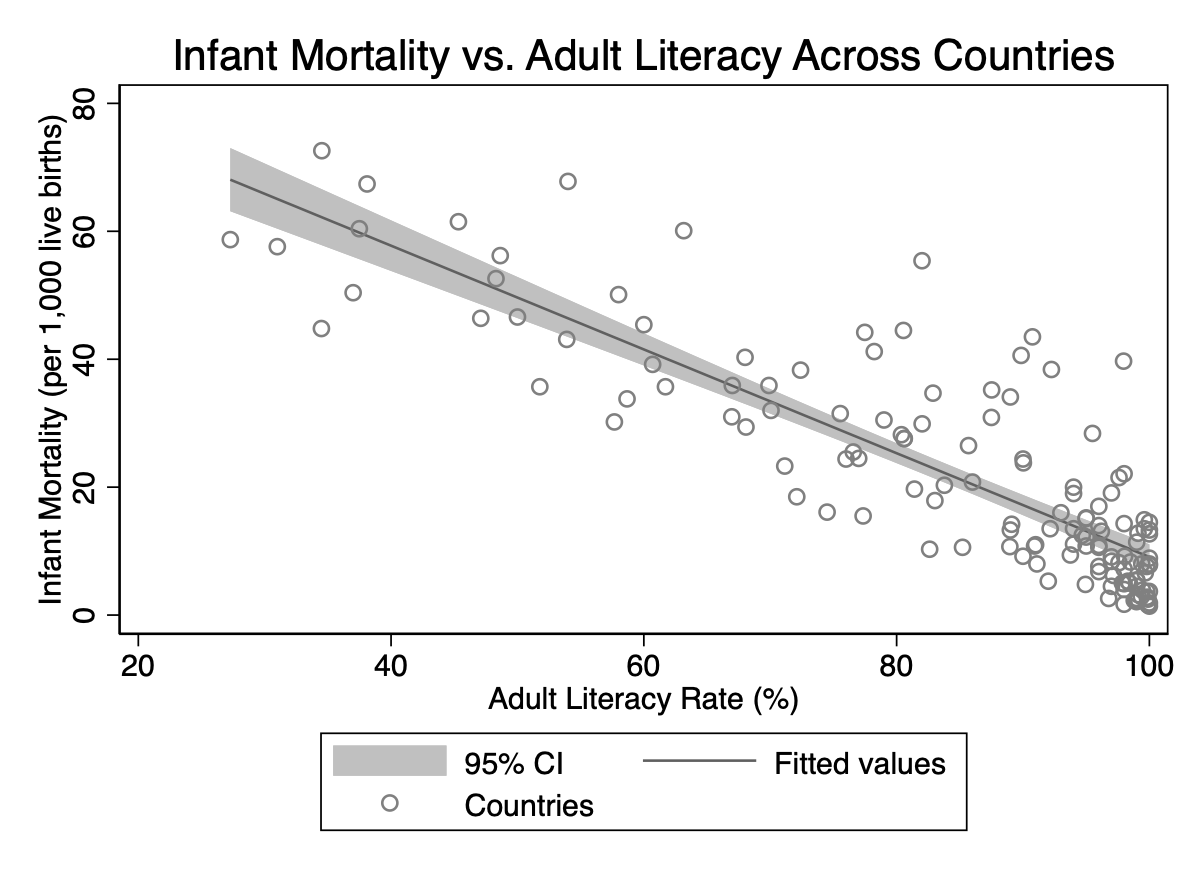
The summary statistics reveal variation across all indicators. GDP per capita ranges from under $300 to over $100,000, while literacy rates span from 27% to nearly 100%. This indicates that there’s wide gap between literacy rate among low and high income countries
Reshape to look deeper into the indicators
To analyze relationships between indicators, we need to reshape the data to wide format where each country is one observation with separate columns for each indicator. We also will replace some series code so that it is more intepretable by the readers.
Code
* Load cleaned datause"wb_cleaned_long.dta", clear* Rename series codes for readabilityreplace seriescode = "gdp"if seriescode == "NY.GDP.PCAP.CD"replace seriescode = "female_literacy"if seriescode == "SE.ADT.LITR.FE.ZS"replace seriescode = "male_literacy"if seriescode == "SE.ADT.LITR.MA.ZS"replace seriescode = "adult_literacy"if seriescode == "SE.ADT.LITR.ZS"replace seriescode = "mortality"if seriescode == "SP.DYN.IMRT.IN"* Drop unnecessary variables and reshapewidedrop id year seriesnamereshapewide seriesvalue, i(countrycode countryname) j(seriescode) string* Rename variables for clarityrename seriesvaluegdp gdprename seriesvaluefemale_literacy female_literacyrename seriesvaluemale_literacy male_literacyrename seriesvalueadult_literacy adult_literacyrename seriesvaluemortality mortality* Save wide-formatdatafor analysissave"wb_cleaned_wide.dta", replacedescribe
(212 real changes made)

(152 real changes made)

(145 real changes made)

(145 real changes made)

(196 real changes made)


(j = adult_literacy female_literacy gdp male_literacy mortality)

Data                               Long   ->   Wide
-----------------------------------------------------------------------------
Number of observations              850   ->   216
Number of variables                   4   ->   7
j variable (5 values)        seriescode   ->   (dropped)
xij variables:
                            seriesvalue   ->   seriesvalueadult_literacy seriesvaluefemale_
> literacy ... seriesvaluemortality
-----------------------------------------------------------------------------


file wb_cleaned_wide.dta saved


Contains data from wb_cleaned_wide.dta
 Observations:           216
    Variables:             7                  13 Jan 2026 23:26
-------------------------------------------------------------------------------------------
Variable      Storage   Display    Value
    name         type    format    label      Variable label
-------------------------------------------------------------------------------------------
countrycode     str3    %9s                   Country Code
countryname     str73   %73s                  Country Name
adult_literacy  float   %8.0g                 adult_literacy seriesvalue
female_literacy float   %8.0g                 female_literacy seriesvalue
gdp             float   %8.0g                 gdp seriesvalue
male_literacy   float   %8.0g                 male_literacy seriesvalue
mortality       float   %8.0g                 mortality seriesvalue
-------------------------------------------------------------------------------------------
Sorted by: countrycode  countryname
Comparing Rich and Poor Countries
One of the way to make the difference obvious between countries to show how severe the inequality is by comparing development outcomes between the richest and poorest countries by GDP per capita. In the table below we will compare the literacy and mortality across top 50 and bottom 50 countries
Code
* Load wide-formatdatause"wb_cleaned_wide.dta", clear* Top 50 countries by GDP per capitadisplay"=== TOP 50 COUNTRIES BY GDP PER CAPITA ==="gsort -gdpsummarize adult_literacy female_literacy male_literacy mortality in 1/50* Bottom 50 countries by GDP per capitadisplay""display"=== BOTTOM 50 COUNTRIES BY GDP PER CAPITA ==="sort gdpsummarize adult_literacy female_literacy male_literacy mortality in 1/50
=== TOP 50 COUNTRIES BY GDP PER CAPITA ===

    Variable |        Obs        Mean    Std. dev.       Min        Max
-------------+---------------------------------------------------------
adult_lite~y |         14    97.79929    1.973078       92.4        100
female_lit~y |         14      97.365     1.95109       92.4        100
male_liter~y |         14    98.09429     2.25755       92.4        100
   mortality |         35    3.451429    1.937763        1.4       11.4


=== BOTTOM 50 COUNTRIES BY GDP PER CAPITA ===

    Variable |        Obs        Mean    Std. dev.       Min        Max
-------------+---------------------------------------------------------
adult_lite~y |         47    65.98271    19.28016      27.28       99.6
female_lit~y |         49    60.33596    22.55905      18.87       99.5
male_liter~y |         47    72.53659    16.63416      35.78       99.7
   mortality |         50      39.714    14.24526       14.3       72.6
The gap is striking for infant mortality, the highest mortality rate among wealthy countries (11.4 death per 1000 live births) is lower than the lowest rate among poor countries (14.3 death per 1000 live births). It indicates a wide gap and systemic differences in health infrastructure.
Distribution Analysis
The distribution of GDP per capita reveals important insights about global inequality. The median ($8536) is much lower than the Mean ($22654) which indicates there’s more low income countries globally
Code
* Load wide-formatdatause"wb_cleaned_wide.dta", clear* Detailed distribution statisticssummarize gdp, detail
                       gdp seriesvalue
-------------------------------------------------------------
      Percentiles      Smallest
 1%      433.174       153.9302
 5%     806.9457       413.7579
10%     1016.089        433.174       Obs                 212
25%     2703.279       508.3713       Sum of wgt.         212

50%     8536.106                      Mean           22654.69
                        Largest       Std. dev.      33300.99
75%     31438.36       137516.6
90%      56833.2         138935       Variance       1.11e+09
95%      85809.9       207973.6       Skewness       3.302677
99%       138935       256580.5       Kurtosis       18.64592
Regression Analysis
TipCorrelation vs. Causation
In this document, with the correlational relationships that is present, we cannot claim that increasing GDP would cause mortality to fall. Reason is because in data without randomization presents, there could be reverse causality (e.g Lower mortality might cause countries to grow faster instead of Rich countries might cause lower mortality rates), or omitted variables (e.g like institutional quality could drive both mortality and gdp). To reduce this possibility we would require randomization or quasi-experimental methods like Regression Discontinuity Design or Instrumental Variables. Hence all the interpretation here is not causal
Infant Mortality on GDP Per Capita
Code
* Load wide-formatdatause"wb_cleaned_wide.dta", clear* Regression: infant mortality on GDP per capitaregress mortality gdp
      Source |       SS           df       MS      Number of obs   =       192
-------------+----------------------------------   F(1, 190)       =     56.73
       Model |  12487.5383         1  12487.5383   Prob > F        =    0.0000
    Residual |  41822.6659       190  220.119294   R-squared       =    0.2299
-------------+----------------------------------   Adj R-squared   =    0.2259
       Total |  54310.2041       191  284.346619   Root MSE        =    14.836

------------------------------------------------------------------------------
   mortality | Coefficient  Std. err.      t    P>|t|     [95% conf. interval]
-------------+----------------------------------------------------------------
         gdp |   -.000278   .0000369    -7.53   0.000    -.0003508   -.0002052
       _cons |   23.98073   1.274607    18.81   0.000     21.46654    26.49493
------------------------------------------------------------------------------
Each additional $1,000 in GDP per capita is associated with approximately 0.27 fewer infant deaths per 1,000 live births. The negative coefficient aligns with expectations: wealthier countries typically have better healthcare infrastructure. And the difference is statistically significant with p-value < 0.05
Literacy on GDP Per Capita
Code
* Load wide-formatdatause"wb_cleaned_wide.dta", clear* Regression: adult literacy on GDP per capitaregress adult_literacy gdp
      Source |       SS           df       MS      Number of obs   =       142
-------------+----------------------------------   F(1, 140)       =     33.03
       Model |  9077.13217         1  9077.13217   Prob > F        =    0.0000
    Residual |  38470.2731       140  274.787665   R-squared       =    0.1909
-------------+----------------------------------   Adj R-squared   =    0.1851
       Total |  47547.4053       141   337.21564   Root MSE        =    16.577

------------------------------------------------------------------------------
adult_lite~y | Coefficient  Std. err.      t    P>|t|     [95% conf. interval]
-------------+----------------------------------------------------------------
         gdp |   .0004964   .0000864     5.75   0.000     .0003256    .0006672
       _cons |   78.89866   1.711204    46.11   0.000     75.51552    82.28181
------------------------------------------------------------------------------
Higher GDP is associated with higher literacy rates, though the relationship is modest in magnitude. Each additional $1000 increase GDP is associated with increases in adult literacy by 0.04.
The persistent gap between male and female literacy rates reflects socio-cultural norms in many low- and middle-income countries that historically prioritized boys’ education.
Conclusion
The exploratory analysis reveals pattern that gap between the richest and poorest countries isn’t just about income but also manifest in infant survival rates, literacy and gender disparities in education. The correlations here can’t tell us whether raising GDP would improve health outcomes or whether causal relationships exist between these indicators. Still, exploratory analysis like this can generate hypotheses worth testing with quasi-experimental or experimental methods in future work. On a practical note, I found Stata’s syntax efficient for this kind of work. Reshaping and regression tale just a view line of code. I hope this serve as a useful reference for data exploration using Stata